
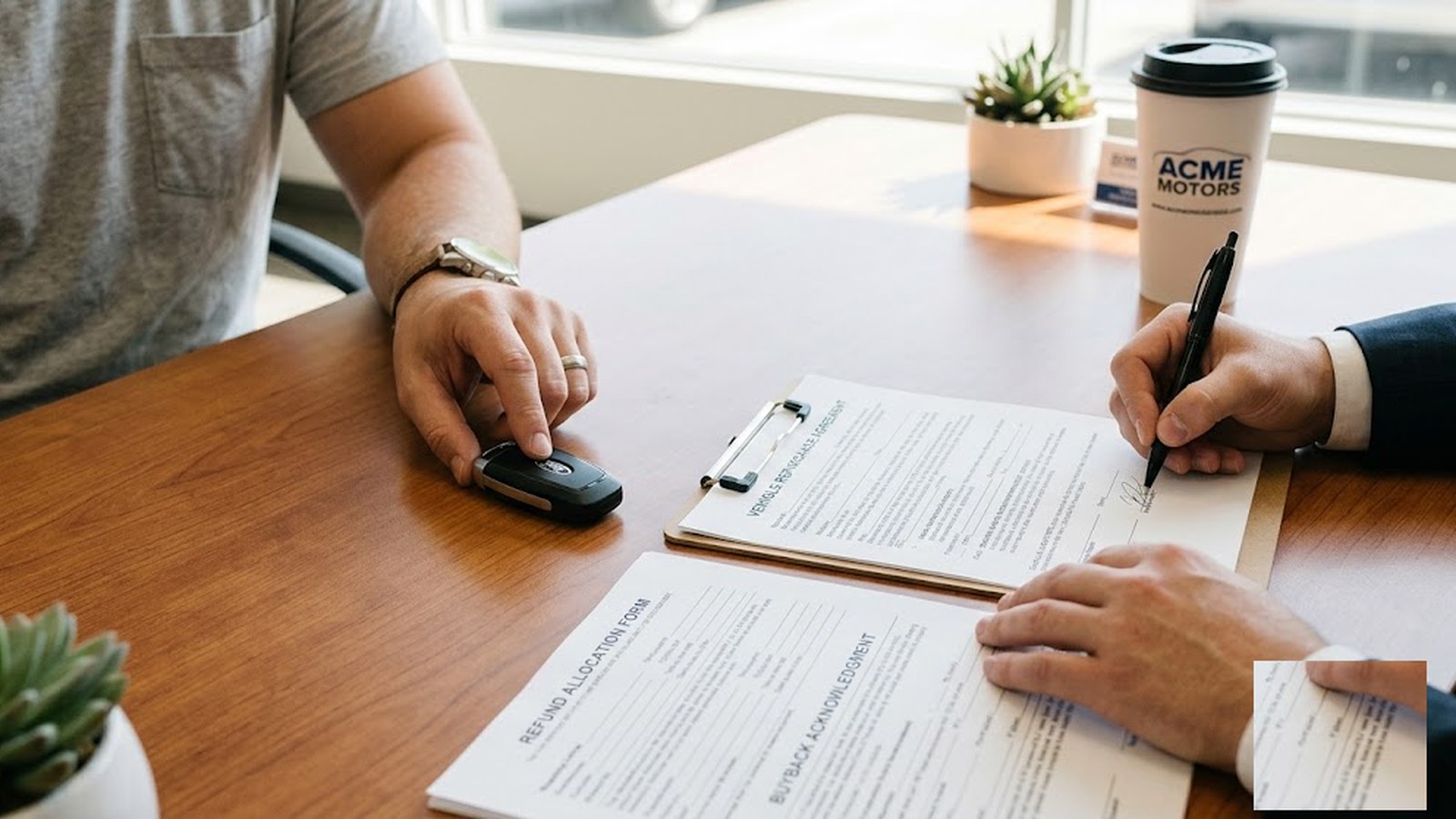
A buyback, also called a repurchase, is when the manufacturer takes back your defective vehicle and refunds what you paid, your down payment, monthly payments, and remaining loan balance, minus Statutory Deductions.




 Written by Babak Hashemi, Esq.
A buyback, also called a repurchase, is when the manufacturer takes back your defective vehicle and refunds what you paid, your down payment, monthly payments, and remaining loan balance, minus Statutory Deductions.
A buyback unwinds your purchase: the manufacturer returns your money and takes back the car. It is one of the two main remedies under California's lemon law, the other being a replacement vehicle.
The refund is reduced only by a limited statutory deduction for your early use of the vehicle.
A proper buyback covers your down payment, the monthly payments you have made, and the payoff amount still owed to the lender. It typically also includes incidental costs such as taxes, registration, finance charges, towing, and rental expenses.
The manufacturer is allowed to apply Statutory Deductions for the miles you drove before you first brought the car in for the defect. Miles driven after that first repair attempt generally are not counted against you.
This keeps the deduction small in most qualifying cases.
You usually get to choose between a buyback and a comparable replacement vehicle. A buyback is often better if you want out of the car entirely, while a replacement keeps you in a working vehicle of similar value.
You may be entitled to a buyback when a warranty defect substantially impairs the vehicle and has not been fixed after a reasonable number of repair attempts.
Good repair records are what prove it.
This article is general information, not legal advice. To find out whether you qualify for a buyback, contact The Hashemi Law Firm for a no fee case evaluation.
In a financed or leased vehicle the lender is paid directly as part of the repurchase, which is why the payoff amount is part of the calculation rather than something the owner settles separately.
Owners are sometimes surprised that the figure they receive differs from the total they have paid; the loan payoff is the usual reason.
A buyback does not generally require the vehicle to be in perfect condition, though damage unrelated to the defect can come up in negotiation.
Aftermarket modifications can complicate a claim if a manufacturer argues they contributed to the defect, so disclose them early.
Learn more about our California lemon law practice, or read related articles on our blog.
The Hashemi Law Firm represents clients throughout California from two Orange County offices — Foothill Ranch and Costa Mesa — with service across the San Francisco Bay Area and the Inland Empire and San Diego. Call (949) 464-8529 or contact us for a no fee case evaluation.
Every situation is different. For advice about your specific matter, contact The Hashemi Law Firm for a no fee consultation.
A vehicle buyback is a repurchase in which the manufacturer takes back a defective vehicle and refunds the down payment, payments made, and remaining loan balance, less Statutory Deductions.
In most qualifying cases the consumer may choose between a repurchase and a comparable replacement vehicle.
Generally yes. Stopping payments can create credit and repossession problems separate from the lemon law claim.
Send us a few details and we’ll reach out. No fee, no obligation.
Get a no-fee, no-obligation case evaluation today.